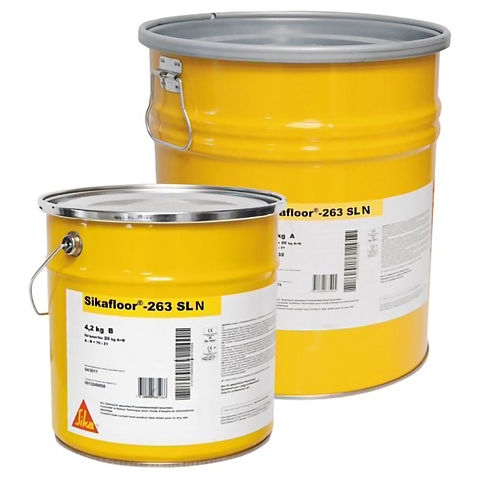
Sikafloor 263 SLN, Rezina epoxidica autonivelanta, 20Kg

SIKA
Sika is a global leader in specialty chemicals for the construction and industrial sectors. The company develops and supplies innovative products and systems for bonding, sealing, damping, reinforcing, and protecting structures. With a strong focus on sustainability and performance, Sika serves a wide range of applications including concrete production, waterproofing, roofing, flooring, and structural strengthening.
Read moreTwo-component self-leveling epoxy resin floor finish Sikafloor®-263 SL N is a two-component, colored epoxy resin that can provide a high-wear, joint-free, low-maintenance, smooth glossy or non-slip finish by spreading quartz sand of various grades. Thicknesses can vary from 1.5 mm (0.0591 in) to 3.0 mm (0.118 in). For medium-heavy wear conditions. Indoor use. | |||||||||||||||||||||||||||||||||||||||||||||
Use
Advantages
pack
Color
RAL 1001, 6021, 7030, 7032, 7035, 7037, 7038, 7040, 7042, 9002 Other colors on request. Through direct exposure to the sun, color variations and discolorations may occur; this does not influence the functionality and performance of the cover. | |||||||||||||||||||||||||||||||||||||||||||||
Typical technical data
| |||||||||||||||||||||||||||||||||||||||||||||
ApplicationMixture ratio Component A : component B = 79 : 21 (by weight) Ambient air temperature +10 °C (+50 °F) min. / +30 °C (+86 °F) max. The relative humidity of the air 80 % u.r. max. Dew point Beware of condensation! The temperature of the substrate and uncured material on the surface must be at least 3˚C higher than the dew point, to reduce the risk of condensation and delamination of the finished surface. Note: Conditions of low temperatures and high humidity increase the probability of surface delamination. Support temperature +10 °C (+50 °F) min. / +30 °C (+86 °F) max. Moisture content in the substrate < 4 % pm moisture content. Test method: Sika®-Tramex-meter, CM - carbide measuring method or oven drying method. Rising moisture is not recommended, according to ASTM standards (polyethylene sheet test). Lifetime of the mixture
Hardening time Before overcoating with Sikafloor®-263 SL N, a waiting time is allowed as follows:
Times are approximate and are affected by changes in ambient conditions, especially temperature and relative humidity. The applied product is usable after
Consumption ~0.9–1.2 kg/m²/mm These values are theoretical and do not take into account additional consumption due to surface porosity, surface profile, unevenness or losses, etc. For detailed information, please refer to the Sikafloor® Multidur ES-20 and Sikafloor® Multidur EB-27 system data sheets. shuffle Before combining, mechanically mix component A. After the entire amount of component B has been added to component A, continue mixing for 3 minutes until a homogeneous mixture is obtained. After mixing components A and B, add quartz sand and if necessary Extender T and mix for another 2 minutes, until a homogeneous mixture is obtained. To ensure that they have been properly mixed, pour the contents into another container and mix again until a consistent mixture is obtained. Prolonged mixing should be avoided to minimize aeration of the mixture. Mixing tools Sikafloor®-263 SL N must be thoroughly mixed using an electric mixer with low rotation speed (300 – 400 rpm) or other suitable equipment. For the preparation of the mortar, mixers are used with forced mixing and a rotating tub, with a mixing paddle or tub. No free-fall mixers are used. APPLICATION Strictly follow the instructions provided in the application methods which must always be adapted to the actual site conditions. Before application, check the humidity of the support, u.r. and the dew point. If the humidity of the substrate is > 4%, apply Sikafloor® EpoCem® as a temporary barrier against humidity (B.T.U. system). Primer: Make sure a continuous, non-porous layer covers the substrate. If necessary, apply two coats of primer. Apply Sikafloor®-156 / -160 / -161 by brush, roller or rubber squeegee. The recommended application is by stretching with the rubber trowel and finally, the uniformity of the primer by rolling with the stencil in two perpendicular directions, in a cross. Leveling: Rough surfaces must be leveled first. That's why you use e.g. leveling mortar based on Sikafloor ®-156/-161/-160 (see product data sheets). Self-leveling finish: Sikafloor®-263 SL N is poured and spread evenly using a notched trowel/ rake pin squeegee to the required thicknesses. Apply the spiked roller immediately in two perpendicular, criss-cross directions to remove trowel marks, help release entrapped air, ensure an even coat and achieve the required surface finish. Anti-slip coating by spreading quartz sand: Sikafloor®-263 SL N is poured and spread evenly using a notched trowel/ rake-type pin squeegee to the required thicknesses. Apply the spiked roller immediately in two perpendicular directions to help release entrapped air and ensure an even coat. After about 15 minutes (at 20°C (68 °F)) but before 30 minutes (at 20°C (68 °F)), spread quartz sand, first lightly and then in excess to achieve an evenly distributed surface profile. Allow Sikafloor®-263 SL N to harden and remove all friable sand with vacuum equipment. Apply the final sealing layer Sikafloor®-263 SL N with the squeegee at a consumption of 0.6 - 0.8 kg/m 2 to completely embed the sand. Then apply the stencil with short hair in two perpendicular directions, in a cross. CLEANING OF TOOLS Clean all tools and application equipment with Thinner C immediately after use. The already hardened material can only be removed mechanically. |