
Sikaflex-953 L30, 2-Part STP Adhesive with Long Open Time, Interior & Exterior, White, 490 mL
SIKA
Sika is a global leader in specialty chemicals for the construction and industrial sectors. The company develops and supplies innovative products and systems for bonding, sealing, damping, reinforcing, and protecting structures. With a strong focus on sustainability and performance, Sika serves a wide range of applications including concrete production, waterproofing, roofing, flooring, and structural strengthening.
Read more| Long open time, fast-curing, 2-component STP assembly adhesive / sealant Sikaflex-953 L30 is a 2-component Silane Terminated Polymer (STP) assembly adhesive which cures by chemical reaction of the two components. The L30 version is designed for bonding large components where a longer open time is required. Owing to its good weathering resistance and gap-filling performance it can also be used for exterior sealing joints. It's especially suitable for pumping over long distances.
| |||||||||||||||||||||||||||||||||||||||||||||||||||||
PRODUCT BENEFITS
UsageSikaflex-953 L30 is suitable for bonding large components exposed to dynamic stress and where the attainment of early strength is required. Common substrates are metals, particularly aluminium (including anodised), steel (including phosphated, chromated, galvanised), metal primers and paint coatings (2-part systems), ceramic materials and plastics. Seek manufacturer’s advice and perform tests on original substrates before using Sikaflex-953 L30 on materials prone to stress cracking. This product is suitable for experienced professional users only. Tests with actual substrates and conditions have to be performed ensuring adhesion and material compatibility.Packaging
| |||||||||||||||||||||||||||||||||||||||||||||||||||||
Typical Product Data
| |||||||||||||||||||||||||||||||||||||||||||||||||||||
Technical Information CURE MECHANISM The curing of Sikaflex-953 L30 takes place by chemical reaction of the two components. Time [h] Strength [MPa] 2 0.2 4 0.6 6 0.8 Table 1: Lap-shear strength (CQP 046-1) at 23 °C / 50 % r.h. CHEMICAL RESISTANCE Sikaflex-953 L30 is generally resistant to fresh water, seawater, diluted acids and diluted caustic solutions; temporarily resistant to fuels, mineral oils, vegetable and animal fats and oils; not resistant to organic acids, glycolic alcohol, concentrated mineral acids and caustic solutions or solvents. | |||||||||||||||||||||||||||||||||||||||||||||||||||||
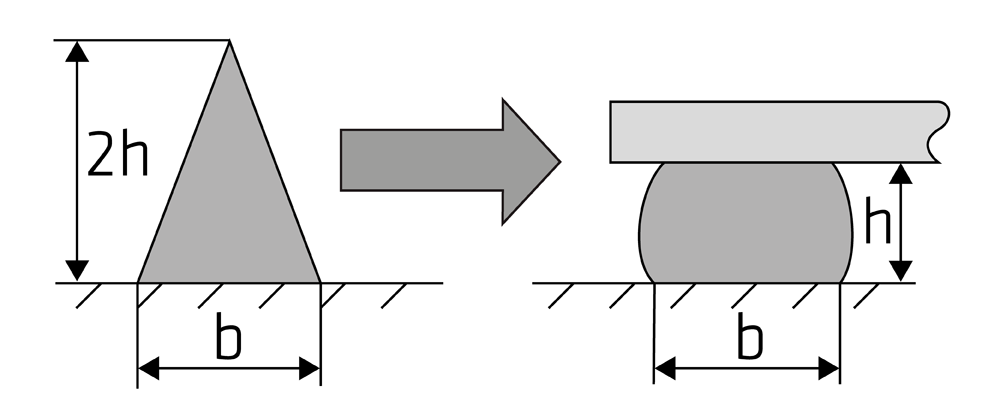
Application Information Surface Preparation Surfaces must be clean, dry and free from grease, oil, dust and contaminants. Surface treatment depends on the specific nature of the substrates and is crucial for a long lasting bond. Application Sikaflex-953 L30 can be processed by cartridge or with a suitable dispensing system. The mixer type needs to be respected. For dispensing systems the mixer type is stated in the Typical Product Data table, whereas for cartridges it is stated under Packaging Information. To ensure a uniform thickness of the bondline it is recommend to apply the adhesive in form of a triangular bead (see figure 1).
Figure 1: Recommended bead configuration The open time is significantly shorter in hot and humid climate. The parts must always be joint within the open time. As a rule of thumb, a change of + 10 °C reduces the open time by half. Tooling and finishing Tooling and finishing must be carried out within the open time of the adhesive. We recommend the use of Sika Tooling Agent N. Other finishing agents must be tested for suitability and compatibility. Removal Uncured Sikaflex-953 L30 can be removed from tools and equipment with Sika Remover-208 or another suitable solvent. Once cured, the material can only be removed mechanically. Hands and exposed skin have to be washed immediately using hand wipes such as Sika Cleaner-350H or a suitable industrial hand cleaner and water. Do not use solvents on skin. Overpainting Sikaflex-953 L30 can be best painted within the skin formation time. If painting process takes place after the sealant has built a skin, adhesion could be improved by treating the joint surface with Sika Aktivator-100 or Sika Aktivator-205 prior to paint process. If the paint requires a baking process (> 80 °C), best performance is achieved by allowing the sealant to fully cure first. All paints have to be tested by carrying preliminary trials under manufacturing conditions. The elasticity of paints is usually lower than that of sealants. This could lead to cracking of the paint in the joint area. |
The above design is only a sample of the options available, for reference purposes only. Our policy of continuous improvement may result in a change of specifications without notice. If any discrepencies might be between the data sheet values and standards, we reserve the rights to make technical changes. Our company will not be held responsible, as all or any of pictures, drawings, weights and dimensions details or other elements in this document are only indicative and must not be considered contractual. Contact our sales team for other specifications or custom made products.
Contact our sales team for other specifications or custom made products.| Long open time, fast-curing, 2-component STP assembly adhesive / sealant Sikaflex-953 L30 is a 2-component Silane Terminated Polymer (STP) assembly adhesive which cures by chemical reaction of the two components. The L30 version is designed for bonding large components where a longer open time is required. Owing to its good weathering resistance and gap-filling performance it can also be used for exterior sealing joints. It's especially suitable for pumping over long distances.
| |||||||||||||||||||||||||||||||||||||||||||||||||||||
PRODUCT BENEFITS
UsageSikaflex-953 L30 is suitable for bonding large components exposed to dynamic stress and where the attainment of early strength is required. Common substrates are metals, particularly aluminium (including anodised), steel (including phosphated, chromated, galvanised), metal primers and paint coatings (2-part systems), ceramic materials and plastics. Seek manufacturer’s advice and perform tests on original substrates before using Sikaflex-953 L30 on materials prone to stress cracking. This product is suitable for experienced professional users only. Tests with actual substrates and conditions have to be performed ensuring adhesion and material compatibility.Packaging
| |||||||||||||||||||||||||||||||||||||||||||||||||||||
Typical Product Data
| |||||||||||||||||||||||||||||||||||||||||||||||||||||
Technical Information CURE MECHANISM The curing of Sikaflex-953 L30 takes place by chemical reaction of the two components. Time [h] Strength [MPa] 2 0.2 4 0.6 6 0.8 Table 1: Lap-shear strength (CQP 046-1) at 23 °C / 50 % r.h. CHEMICAL RESISTANCE Sikaflex-953 L30 is generally resistant to fresh water, seawater, diluted acids and diluted caustic solutions; temporarily resistant to fuels, mineral oils, vegetable and animal fats and oils; not resistant to organic acids, glycolic alcohol, concentrated mineral acids and caustic solutions or solvents. | |||||||||||||||||||||||||||||||||||||||||||||||||||||
Application Information Surface Preparation Surfaces must be clean, dry and free from grease, oil, dust and contaminants. Surface treatment depends on the specific nature of the substrates and is crucial for a long lasting bond. Application Sikaflex-953 L30 can be processed by cartridge or with a suitable dispensing system. The mixer type needs to be respected. For dispensing systems the mixer type is stated in the Typical Product Data table, whereas for cartridges it is stated under Packaging Information. To ensure a uniform thickness of the bondline it is recommend to apply the adhesive in form of a triangular bead (see figure 1).
Figure 1: Recommended bead configuration The open time is significantly shorter in hot and humid climate. The parts must always be joint within the open time. As a rule of thumb, a change of + 10 °C reduces the open time by half. Tooling and finishing Tooling and finishing must be carried out within the open time of the adhesive. We recommend the use of Sika Tooling Agent N. Other finishing agents must be tested for suitability and compatibility. Removal Uncured Sikaflex-953 L30 can be removed from tools and equipment with Sika Remover-208 or another suitable solvent. Once cured, the material can only be removed mechanically. Hands and exposed skin have to be washed immediately using hand wipes such as Sika Cleaner-350H or a suitable industrial hand cleaner and water. Do not use solvents on skin. Overpainting Sikaflex-953 L30 can be best painted within the skin formation time. If painting process takes place after the sealant has built a skin, adhesion could be improved by treating the joint surface with Sika Aktivator-100 or Sika Aktivator-205 prior to paint process. If the paint requires a baking process (> 80 °C), best performance is achieved by allowing the sealant to fully cure first. All paints have to be tested by carrying preliminary trials under manufacturing conditions. The elasticity of paints is usually lower than that of sealants. This could lead to cracking of the paint in the joint area. |